
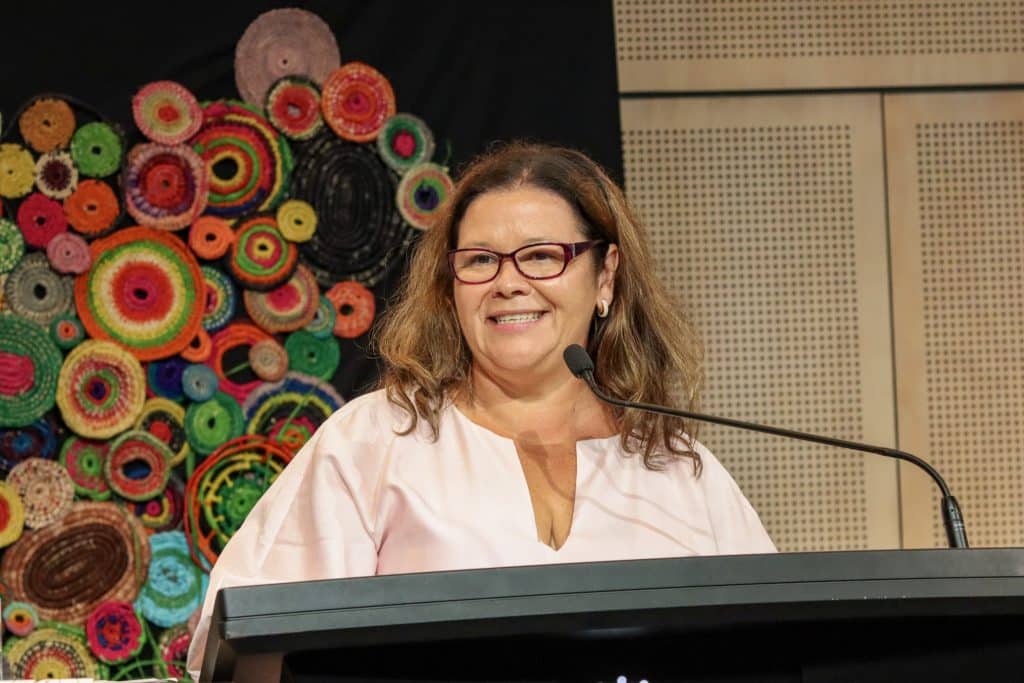
The speech below was delivered by Cape York Partnership Group CEO, Fiona Jose at our 5th International Women's Day Luncheon at the Cairns Convention Centre on Friday 6 March 2026.
Yalada yurra, yulumbarril, ngayu wawu wawu.
I acknowledge the Gimuy Walubara Yidinji people as the Traditional Custodians of this land, and pay my respects to Elders past and present. I acknowledge all First Nations people and allies in this room.
As women, our lives are lived between generations. Across cultures and across time, women have always held life at both ends – we welcome babies and we walk our Elders all the way home. We carry memory and we carry hope. That is our humanity. We are constantly balancing the scales between those who came before us and those who will come after us.
Today, on International Women’s Day, we could spend our time celebrating how far women have climbed – more women on boards, more women in Parliament, more women in corner offices. But I want to talk about the women and children who are still standing on the ground floor, looking up at a ladder that was never built for them. I want to talk about Australia’s Bottom Million – because that is where the true state of our humanity is revealed, and where the scales are most brutally out of balance.
In Australia right now, 161 billionaires make more money than the bottom 40 per cent of our entire population. The elevator to the penthouse is working just fine.
Down at the bottom, it’s a different story. The Bottom Million are the 5% of Australians for whom poverty is not just a bad year, but the family inheritance. Half are First Nations. The other half are non‑Indigenous, migrant, all backgrounds. What they share is not culture. It’s class.
The majority of our people are trapped in this Bottom Million. Our people live in communities where there are no real labour markets, where schools are failing children, and where public housing is a cul‑de‑sac, not a stepping stone. This isn’t random misfortune. It is structural design.
If we truly believe in each other’s humanity, then we cannot accept a country where some children are born with the scales so heavily stacked against them that effort rarely connects to opportunity.
Our country prides itself on the value of a ‘fair go’. But for too many families, the fair go is not the result they experience. The value of the ‘fair go’ must be made a verb – a behaviour this country actually does.
In some parts of Australia, a child can reasonably assume that if they work hard, school will lead to further study or a decent job. In other parts of this same country, children grow up knowing – long before they can find the words for it – that school does not lead to work, that work does not lead to stability, and that a nice future is something that happens somewhere else.
Exclusion does not arrive as one big event. It arrives as a pattern. Towns where there is no real labour market, only short‑term jobs that come and go. Schools where children attend, but do not learn enough to progress with confidence.
Over time, that pattern hardens. What should have been a rough patch becomes the permanent setting of life.
These conditions exist in remote communities, in outer‑suburban streets, and in regional centres. They shape the lives of First Nations people, of migrants, of long‑term working‑class families. Together, they make up the Bottom Million – Australians for whom disadvantage is the default.
And in the midst of that, women – especially First Nations women – are carrying the heaviest load. We are raising children in communities where effort rarely connects to opportunity. We are doing our best in places where violence, addiction and despair are not individual failings but symptoms of systems that were never designed with our families in mind. We hold the households together. We navigate the services. We keep the culture and the kids alive, often while standing on ground that keeps shifting under our feet.
This is what unbalanced scales look like in real life.
Let me tell you what happens when we start to move those scales – and I want to ground this not just in stories, but in numbers.
In most Cape York communities, more than 80 per cent of adults are jobless. Life expectancy is around 30 years shorter than it is here in Cairns or Brisbane. If a youngster stays in their community for high school, their chance of finishing school is almost none. That is what structural “imbalance” looks like in hard data.
Now look at what happens when we put stairs – structured opportunity – under people’s feet.
Through our Student Education Trusts, families on some of the lowest incomes in the country have saved, collectively, six million dollars of their own money for their children’s future – not government money, their money, locked away for school fees, uniforms, books, graduation gowns.
In our Cape York Leaders Program, remote students who would otherwise face a less‑than‑five‑per‑cent chance of finishing school are now completing Year 12 at a rate of 94 per cent. Nearly every student we support into quality schools experiences Year 12 success. Around 70 per cent of those graduates go straight into full‑time work, apprenticeships or further study, and they earn, on average, 50,000 dollars more each year than if they were trapped on welfare.
Remember – behind each of those percentages is a young person who stands only one degree of separation from tragedy, from addiction, from a reason to give up. Yet they succeed.
When a grandmother on the pension in Hope Vale puts aside money for her granddaughter’s high school years, that is a revolution in expectations.
When a young man from Aurukun, who grew up in a house where no one had ever finished school, finishes Year 12 and signs his first employment contract, that is proof that the system can be redesigned.
Our young people have proven that when responsibility is met with structured, reliable opportunity, the gap can close in one generation. But we must be clear about something. There is no elevator out of disadvantage. There is no forklift of social justice that can lift whole communities while everything else stays the same. There must be a staircase – for individuals and families to climb – too many of those steps have been missing or broken.
The tragedy is that we are only funded for around 20 young people a year out of roughly 340 teenagers. We have built the staircase – but only for a lucky few.
That is why I am talking about the Bottom Million. Not because we lack evidence of what works, but because we have a moral and national obligation to scale what works from the few to the many.
Last year, on this day, I stood here and said that Year 12 completion is the powerhouse outcome we are obsessed with – the single most powerful lever we have for closing the gap in one generation. That hasn’t changed.
If we want to see what “balancing the scales” really looks like, don’t look at a boardroom photo - look at a Year 12 graduation photo.
Right now, the scales are shamefully tilted. In mainstream Australia, roughly four out of five young people will finish Year 12. In Cape York, if a child stays in community, their chance of graduating Year 12 is closer to one in 100.
That is what it means, in practice. One side piled high with certificates, ATARs, apprenticeships, uni offers. The other side is almost empty.
We know from two decades of evidence that Year 12 is the gamechanger. When a young person completes Year 12 with real capability, everything else levels. They are more likely to work, to keep earning, to enjoy better health, to stay out of the justice system, and to raise children who do the same.
That is the proof that it is not our kids who are failing. It is the system.
So when we talk about balancing the scales for the Bottom Million, I want us to be very concrete. Balancing the scales means making Year 12 completion with real capability normal, not exceptional – the non‑negotiable threshold.
It is simple – Year 12 is the single best ballast we can place on a young person’s side of the scales.
So where does that leave us – the adults in this room?
We need to be honest about something. First Nations adults are the Gap. Our statistics – our health, our employment, our trauma – are what show up in the Closing the Gap reports. Our children are the chance to close it.
Our task, as adults, is to do the hard work of reshaping ourselves and the systems so that the next generation does not inherit what we did. We are the ones with our hands on the scales right now – in homes, in businesses, in bureaucracies, in parliaments. The question is whether we use that power to keep the scales as they are, or to finally shift weight to the side that has been left empty for too long.
We can draw inspiration from the women on the ground in Cape York.
They are indeed the most powerful force for change in our region. When women move, families move.
I have had the privilege of a working alongside these remarkable women.
Our Founder Noel Pearson said it best:
“There is no more jealous, and no more powerful a driver of progress than the tender regard that a mother has for her own… The mother whose jealous regard is for the prospects of the children is the most powerful engine for social progress.”
Our women know exactly what Noel is saying here.
I would not want to stand between any of you and the future you want for your children – or between you, and your grannies.
Again and again in Cape York, women’s love has become reform.
It was women who wanted more for girls dropping out of school because of pregnancy or other complex issues – these Aunties and Grannies co-designed with us the Cape York Girl Academy.
The Cape York education reform was driven by women - around 80 per cent of the leaders were women like Phillis Yunkaporta, Maureen Liddy, the late Annie Creek, and many more.
Around 90 per cent of those who drove the courageous welfare reforms were women.
Over 70 per cent of those who stood up as Local Commissioners and made the Family Responsibilities Commission work were women.
And every day, women keep driving change with their choices:
- 98 per cent of Cape York Leaders Program applications are from women.
- 81 per cent of donors to Student Education Trusts are women.
- 5 million of the 6 million dollars contributed to education savings accounts come from women.
- 80 per cent of Mayi Market customers are women, stretching every dollar for food for their families.
Again and again Women’s love becomes reform. Their persistence becomes policy. Their insistence becomes social change.
One of the most harmful ideas we live with is the singular notion of Indigenous identity – that there is only one way to be a ‘true black fella’, and that if you succeed in education, business or leadership, you are somehow less authentic.
Our identity cannot be measured in fractions. We are layered. Our foundation layers are our kinship, our culture, our language. On that foundation, life adds other whole layers: I am a daughter, a mother, a wife, an aunty, a colleague, a chief executive, a basketball tragic. None of these layers cancels the others. Each layer builds out who we are and what we are capable of.
Leadership, sits in those layers. We are on the dance floor, in the classrooms, the courtrooms, the hospital wards, the offices – and we are on the balcony, looking upon the whole story.
From the dance floor, we feel the heat, the pressure, the constraints. From the balcony, we can see which stairs are missing, which children are falling through the cracks, which side of the scales is too light or weighed down. Good leaders move between both – close enough to feel, high enough to see.
There is another balance we have to hold – the balance between generations.
Young people are walking through a world we never had to face – constant screens, curated information, manipulated feeds, unprecedented access to information, opinion and constant comparison. They are more anxious, lonely, insecure and less trusting of institutions than any generation before them, and given what they have seen, that is a very logical outcome. They are products of an environment we have allowed to exist.
So when they arrive in our workplaces distrusting, impatient for change, convinced they know more, and that we are “stuck in the mud” – our job is not to dismiss them.
Our job is to show them what A.I. cannot do - the true virtues of real human connection, human judgement, free and critical thinking and human collaboration. Because A.I. is not aligned with human goals. Big Tech is not running to the goals of humans.
We will need our young people to navigate this information revolution, where facts have stopped mattering, and have the capabilities to design better than the failing systems of our time. For this, real human judgement is required.
Because it is International Women’s Day, we really should take a victory lap for women. There are more women on boards. More women in C‑suites. More women “leaning in”.
But, what is the point of more women at the top, if we are not prepared to dismantle the architecture that keeps millions of women and children at the bottom?
At its core, this is not just a policy question. It is a question of humanity.
The world does not need more “empowered” leaders guarding the status quo. The world needs courageous leaders – especially women – who are prepared to use their power to change the rules of the game.
So I want to speak directly to the better angels of your nature – to the part of you that knows power is a responsibility, not a perk.
If you’re in corporate Australia, you have the power to turn “diversity initiatives” into real, structured pathways from the Bottom Million into your workforce. Mentoring is nice. But jobs and entry‑level roles that connect to real learning and progression are transformational.
If you’re in government, you have the power to stop hiding behind programs and start insisting on outcomes. Stop measuring success by how many services you fund. Start measuring it by how many kids from the Bottom Million finish Year 12, get a job, buy a home. Let that be the scale by which your budgets are weighed.
If you’re in an Indigenous‑controlled organisation, you have the power to keep leading from the radical centre – backing our people to take responsibility, and demanding that systems finally deliver opportunity in return. Refuse business‑as‑usual system failure.
Courageous leadership is often not pretty. But if leadership doesn’t cost you anything, it’s probably just cosmetic.
When I look at a young woman from remote Cape York on our Leaders Program – blazer on, ambitions on track, culture in her bones – I have hope for the future.
Her achievement shows what becomes possible when Australia chooses to extend real opportunity to the bottom, and when women who have made it hold the ladders for others.
Our humanity won’t be judged by how neatly we defend the great IMBALANCE in our time, but by whether we close it in hers.
Will she stand alone – or stand among many?
Today, I am not asking you to clap for the women who made it. I am asking you to work with us – to change the system so that more women, more families, more communities, can make it too.
Let’s be the generation of women who refused to simply manage the Bottom Million and instead chose to abolish it.
For the love of our children – I ask you to stand with us.
Yalada.
MAKE AN IMPACT
Your support will empower Indigenous Australians in Cape York and beyond to create positive change in their communities. Every donation, large or small, can create a ripple of change that will span generations.