
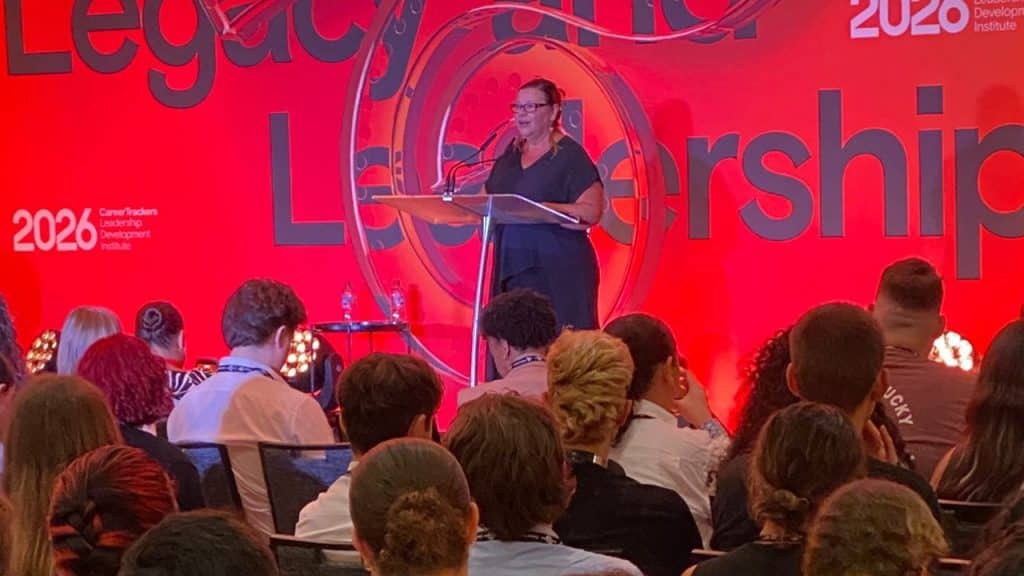
The speech below was delivered by Cape York Partnership Group CEO, Fiona Jose at the CareerTrackers Leadership Development Institute on Wednesday, 4 February, 2026.
Yalada yurra, yulumbarril, ngayu wawu wawu.
I bring greetings from the Cape York Peninsula, and it is my honour to be with you today.
I acknowledge the Traditional Custodians of this land and pay my respects to Elders past, present and emerging. I acknowledge all First Nations people here today - and especially the Career Trackers interns, graduates and alumni in this room. You are living proof of what becomes possible when opportunity meets responsibility.
Today, I’m not here to deliver a résumé.
I’m here to talk about the future - and your role in shaping it.
Because business-as-usual has failed First Nations children and families, and continuing it, is a choice no one can justify any longer.
AND because the decisions made in the next 20 years will determine whether Australia closes the gap - or allows disadvantage to remain a structural inheritance.
I lead the Cape York Partnership Group with a deep sense of responsibility to carry forward the reform legacy of our Founder, Noel Pearson.
Since the referendum, we have been focused on what comes next for Cape York, working alongside more than 100 changemakers from across the region to design our path forward.
Australia is one of the wealthiest nations on Earth.
We pride ourselves on opportunity, fairness, and social stability.
And yet, within that prosperity, a Fourth World reality persists.
This contradiction is very real.
In one part of Australia, children grow up expecting to finish school, get a job, and buy a home - because the systems around them make that path visible and normal.
In another part of the same country, children grow up knowing - long before they can articulate it - that school does not lead to work, that work does not lead to security, and that a nice future is something that happens somewhere else.
That is not a failure of their ambition
It is a failure of architecture.
In parts of this country, children grow up with life expectancies 3-decades shorter than the national average, with little chance of finishing school, finding work, or building a secure life. These conditions are not accidental. They are structured, predictable and inherited.
This is the contradiction at the heart of modern Australia:
a First World nation that tolerates permanent exclusion at the bottom.
When confronted with contradictions like this, we have always looked beyond our own borders here in Australia to learn how others across the world have responded - not to imitate, but to understand what it takes to shift systems.
In the United States, following the great civil rights victories of the 1960s, leaders recognised that legal equality alone did not dismantle economic exclusion. They turned to the harder work of securing access to jobs, education, housing, and decent income - articulated in what became known as the Freedom Budget.
While that agenda was never fully realised. Its insights have endured.
What a privilege it is to have Martin Luther King the 3rd speak to us today. His presence reminds us that the pursuit of equality and justice does not belong to one generation or one country.
Australia has now reached its own Freedom Budget moment - a moment to confront our greatest contradiction directly, and to build the institutions mandated to ensure opportunity is real for those at the bottom.
I do this work because I have spent my life inside systems - first as a child shaped by them, and later as a leader trying to reform them.
What I have learned is this- expectations are never just personal beliefs or cultural attitudes. They are institutional decisions.
They are embedded in curriculum design, assessment standards, teaching methods, welfare rules, labour-market settings, and housing policy. They are revealed not in what systems say, but in what they prepare people for - and what they quietly assume they will never reach.
I learned this before I had language for it.
As a child, I loved school. I loved reading, learning, and being good at it. I moved through primary school confident that effort would be met with progress. That belief was reasonable - and reinforced by early success.
Then I entered high school, and something shifted.
My ability did not disappear. My curiosity did not disappear. What changed was the system’s response when I struggled.
I had been taught to the class level - and, more tellingly, to an “Indigenous level” - not to the grade level. When gaps appeared, there was no urgency to close them. I was still praised, but always with a qualifier. I was doing well for an Indigenous kid. I was a ‘good role model’.
The language used for other kids was the language of standards and progression - the next subject, the next level, the next pathway.
For me and many others, the language was different.
The response was not remediation. It was reassurance. ‘You’re doing well’ - attendance and behaviour became the measures of success, not mastery.
No one said, you need to catch up so you can keep going.
The system adjusted instead - lowering the demand, slowing the pace, and redefining success.
That is how expectations operate in practice - through the way systems are configured, governed, and allowed to default.
One of the most damaging consequences of low expectations is not only what they do to outcomes - it is what they do to identity.
Too often, Indigenous identity is treated as finite and divisible - as though achievement dilutes authenticity.
If you are cultural, you are not academic. You’re not a ‘true black fulla’ if you have a degree.
If you succeed in mainstream institutions, you are less Indigenous.
If you lead, you have somehow stepped away from your people.
This is wrong.
We, our people, are not singular.
And our identities are not fractional. We are not a ‘percentage’ Indigenous.
We are layered.
Culture, language, kinship, and Country are foundational.
They are not diminished by education, work, or leadership.
They hold everything else.
On that foundation, life adds layers - not in parts, but in full.
I am a daughter - wholly - 100% a daughter not 50% of me
I am a mother - wholly - 100% - not 25% of me
I am a CEO - wholly - not 30 % of me
I am Aboriginal and Torres Strait Islander- wholly - it is another layer of me.
None of these layers subtract from the others.
Each was built over time - because opportunity made it possible.
Low expectations flatten identity.
Opportunity allows identity to grow.
Years later, working in Cape York, I recognised the same pattern playing out at scale.
Parents were sending their children to school. Attendance improved. Families were doing what was asked.
But classrooms did not convert attendance into learning. Children moved through year levels without mastering literacy or numeracy. By high school, many disengaged entirely.
This was not about effort or values.
It was about a system that accepted Indigenous educational failure as normal.
It was about a system that tolerated failure - and had no accountability mechanism to correct it. This is the status quo.
Australia’s welfare state works reasonably well when disadvantage is temporary - cushioning short-term shocks such as job loss or illness, and supporting re-entry into work where labour markets are functioning and accessible.
But for others, it traps them in a permanent underclass.
Where labour markets are thin, absent, or inaccessible - whether in remote regions or in parts of our cities - welfare becomes a long-term substitute for opportunity rather than a bridge back to it.
Passive welfare becomes a mechanism for managing exclusion rather than ending it.
People are asked to take responsibility in systems that do not connect effort to opportunity.
Australia’s model of the Welfare State has created a Bottom Million of Australians - Indigenous and non-Indigenous - for whom poverty, unemployment, and exclusion are not temporary, but inherited.
About half are First Nations people.
About half are non-Indigenous and other migrants for whom unemployment and poverty have become intergenerational.
What they share is not culture. It is class-based structural exclusion.
This is why the Bottom Million is not only a remote story.
In parts of Western Sydney, Melbourne’s outer suburbs, and regional towns, labour markets exist - but access to them does not.
Jobs are there, but pathways are broken.
Credentials are required but never built.
Responsibility is demanded, but opportunity is not accessible.
The result is the same exclusion - just closer to the city.
Here is the cruel and diabolical contradiction at its core.
Unemployment and poverty at the bottom are not policy failures.
They are policy mechanisms.
Politicians insist on the dignity of work - while designing an economy that requires a permanent buffer of unemployed people to stabilise prices and wages.
That buffer is about 5% unemployment that is tolerated.
Responsibility is demanded. But opportunity is rationed.
The costs are borne by the same families, generation after generation.
This contradiction cannot be managed away.
It must be corrected.
This contradiction produces, and is produced by, the Opportunity Gap - the gap between what people are asked to do and what the system enables them to achieve.
In Cape York:
- life expectancy is 30 years shorter
- Year 12 completion is almost non-existent is less than 5%
- Indigenous joblessness exceeds 80 per cent in most communities
- Opportunity is missing — across education, jobs, homes, health, and income.
Cape York has not stood by - we’ve looked to great thinking and success in other parts of the world
From Amartya Sen, we learned that intergenerational poverty and disadvantage requires the building of capability - to take up opportunity.
From Singapore, we learned that structured, supported opportunity - education, savings, assets - changes behaviour across generations.
From America’s GI Bill, we learned that guaranteed opportunity can rebuild a nation.
And from the Freedom Budget, we learned that ending entrenched poverty requires a universal, class-focused (not race), and time-bound commitment.
From this intellectual lineage came our theory of change:
Responsibility + Opportunity = Capability
Responsibility without opportunity is despair.
Opportunity without responsibility is passivity.
Together, sustained over time, they build capability.
Our Cape York Leaders Program, The Family Responsibilities Commission, our Opportunity Products have proven the formula.
When students orbit from their communities to high-quality schools in more advantaged places, are supported, expected to achieve, and given pathways beyond school, Year 12 completion exceeds 90 per cent.
Not because these youngsters were exceptional, but because the system finally expected and supported them to succeed.
We came to understand progress as a staircase.
There is no elevator. No forklift of social justice, lifting whole populations.
Progress happens when families climb - step by step.
Governments cannot climb the stairs for people.
But governments must provide the stairs.
For decades, crucial steps have been missing:
health, education, housing, infrastructure - the foundations people need to stand on their own feet.
This logic leads to an Opportunity Economy.
Not “spray and pray” programs.
But structured, guaranteed opportunity where responsibility is met with supported opportunity, with accountability for outcomes.
We are not tinkering around the edges. We are proposing Australia’s own Freedom Budget - the Personal Responsibility and Opportunity Act.
A time-bound, structural commitment to abolish entrenched poverty by guaranteeing opportunity.
It will:
- guarantee education and work pathways as legal entitlements
- link responsibility with opportunity through case-managed reform
- support asset-building, including home ownership
This is not a bigger welfare state. It is an Opportunity Economy
The PR+O Act is designed for one generation - 21 years.
By mid-century - 2050, a child born in Cape York will have the same chance to finish school, work, own a home, and raise a family with the same basic opportunities as any other Australian.
One greatest lesson from Cape York stands above all others.
If you want to close the gap in one generation, you must get children to Year 12 - and you must get them there with real capability.
Year 12 completion is the most powerful lever we have for changing life trajectories.
When young people finish school, everything else becomes more likely:
further education and training, stable work, higher lifetime earnings, better health, stronger families, and a real chance to build assets … they – you - break the cycle
When they do not, disadvantage compounds quickly and predictably.
Year 12 completion for us is not a target, it’s the threshold
Think about what has to go right for a child to finish Year 12.
- It starts before birth - with a healthy pregnancy, good food, a safe home, drug free incubation for a healthy brain.
- It continues in early childhood - with language development, pre-literacy, happiness and safety, and stability.
- In primary school - with real and thorough literacy and numeracy, not time served. This is so critical – if a child is not at reading benchmark in Year 3 it is unlikely they will catch up.
- In adolescence - with supported quality education, belonging, and adult authority.
- And finally - with a visible path beyond school that makes effort worth it.
When any one of those stages fails, Year 12 becomes unlikely.
When all of them are present, Year 12 becomes normal.
Children do not disengage from school suddenly in Year 10 or 11.
If early childhood development is weak, they start school behind the 8-ball
If primary schooling does not build literacy and numeracy, confidence collapses, catch up is unlikely and disengagement is inevitable.
This is why Year 12 completion cannot be treated as a stand-alone reform.
It is the product of a sequence of opportunities, delivered reliably from baby in the belly, with a healthy happy brain.
Our Cape York Leaders Program is the proof. Our youngsters are completing Year 12 at a rate of 94%.
It is because of this structured opportunity that catches kids up and supports them through secondary into further pathways.
These young ones are outliers, the lucky few, approximately 30 kids each year out of 300 Cape Yorkers heading into high school each year.
We need Year 12 completion to be the norm, not the exception.
The PR+O Act will convert opportunity from a nice-to-have offering into a legal entitlement.
Under the Act, access to quality education pathways, school-to-work transitions, and asset-building opportunities is no longer dependent on location, funding cycles, or bureaucratic administrative discretion.
If a family meets its responsibilities - ensuring school attendance, engaging with case planning, supporting learning - the system is obligated to deliver opportunity in return.
This is the most important shift in the Act.
It moves us from promises to guarantees.
From aspiration to accountability.
The Act is built around life-stage sequencing, because capability compounds - and failure at one stage weakens every stage that follows.
The PR+O Act guarantees opportunity across six linked stages:
- early childhood foundations
- primary schooling that delivers literacy and numeracy
- secondary schooling through to Year 12 completion
- a supported transition into work, training, or further study
- stable adult work and family formation
- pathways to savings and home ownership
Each stage is designed to prepare for the next. No crucial opportunity is left to chance.
This is how Year 12 completion becomes achievable at scale - not through pressure at the end, but through support all the way through.
When these opportunities are present - and when families are supported to take responsibility - Year 12 completion stops being exceptional.
It becomes normal.
We say- from Cape York to New York.
Grounded in family and home. Able to orbit the world.
Carrying culture, always.
Our young people are already proving this is possible. You are proving what’s possible.
This is our Freedom Budget moment.
The gap can close - within one generation.
For the love of our People
Yalada. Thank you
MAKE AN IMPACT
Your support will empower Indigenous Australians in Cape York and beyond to create positive change in their communities. Every donation, large or small, can create a ripple of change that will span generations.