
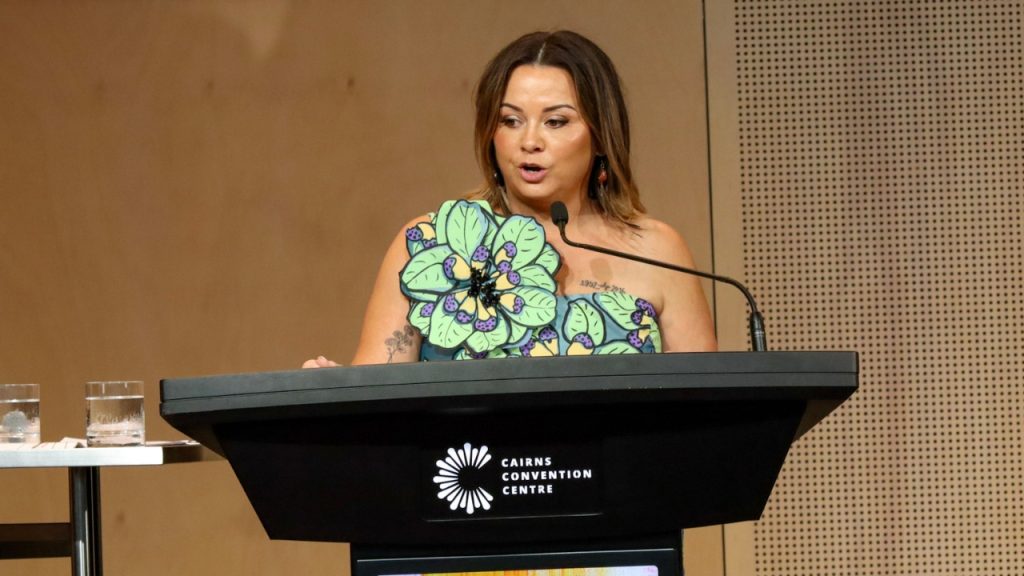
The speech below was delivered by Cape York Institute for Policy and Leadership CEO, Kirsty Davis at CYP's 5th International Women's Day Luncheon at the Cairns Convention Centre on Friday, 6 March 2026.
I acknowledge the Gimuy Walubara Yidinji people, whose hands have been weaving story, law and belonging into this Country for two‑and‑a‑half‑thousand generations.
I pay my respects to their Elders, and to all First Nations women and men here today especially our Bama sisters from across Cape York, ensuring their rich languages and cultures are entwined into the lives of their children.
When I read “balancing the scales”, I automatically think of equality and justice.
For us at Cape York Institute, it has a very concrete meaning.
It is about balancing responsibility with real opportunity – supporting people to take responsibility for themselves and their families, and making sure that effort is met with quality, reliable opportunity from the systems around them.
In Cape York, women do the heavy lifting on the responsibility side.
Every day, they hold many strands at once.
They raise children, care for Elders, preserve language, keep culture and kinship strong.
They keep food on the table, get kids to school, advocate, and navigate clinics, Centrelink offices, housing and the law.
But the perennial question is whether systems will meet them with strands of opportunity.
Until we back in early childhood education, quality schools, affordable food, real work and the basic life chances other Australians take for granted, a strong social fabric will always be hard to achieve.
Two words are synonymous with deadly Bama women: weaving and yarning.
The word “yarn” once simply meant spun fibre – thread prepared for weaving.
Sailors later used it for the long stories they told while twisting rope, “spinning a yarn” to pass the time.
In Aboriginal English it came to mean talking and storytelling – yarning.
- A few chairs on a verandah.
- A shady tree at the back of the art centre.
- Hands busy with grass stripped and dyed
- Voices rising and falling in quiet conversation, squeals, laughter
- Women sit together, circular formation, working grass yarn in their hands, lips yarning.
They are bonding, unknotting problems, threading priorities, weaving ideas and solutions.
Inside that circle, serious work is happening.
One strand of fibre on its own is light and easy to break.
Many strands, woven over and under, become a mat that can carry weight, a basket that can hold what matters.
One story is powerful, but many stories shared together become a pattern – a clear picture of what children are facing, what is working, AND what must change.
Across Cape York, we see this in action.
In Lockhart River, women use weaving and art to speak for children – putting their concerns and hopes into designs that carry into conversations with services, schools and leaders.
In Mossman Gorge, women have sat in circle to design their own community development plans –mapping what they want for their kids, their safety and their opportunities, and how they want to work together to get there.
In Hope Vale, women have held firm on expectations for school, respect in the home, and backing each other to keep going – keeping reform on track through consistency and example.
This is not casual chit‑chat.
It is Indigenous governance – participation, inclusion, advice, collaboration, mentoring, respect and lore in practice.
If we are to ‘balance the scales’ we need to:
Recognise weaving circles, yarn circles and kitchen tables as real leadership and design spaces – the first place where issues are named and solutions are sketched.
Create clear paths so the thought-gems discussed in those circles can move into development, design, investment and policy – not as an afterthought, but as the starting point.
Weaving and yarning is a space like no other – bringing together hearts and minds – learning and sharing life challenges and lessons, laughing, crying, bonding, strand by strands growing the social fabric of communities.
Now, more than ever, we need to encourage our young girls to leave their devices and come sit with us – under the tree, by the river, or in the backyard, to feel the fibre, hear the yarns that only Elders know, to know the aspirations of our old people, their strong love, strong boundaries and strong culture.
No App or A.I can do that.
Today I’d like to pay tribute to the women whose leadership begins with weaving and yarning – whose circles are some of the oldest and strongest institutions we have.
It is my pleasure to share with you the joy and strength of women and weaving. From Lockhart River, Mossman Gorge and Hope Vale our hands, hearts, and voices connect in an effort to create something strong and beautiful.
To craft a really strong social fabric for our children, we cannot be missing threads.
Everyone with yarn must bring it and join the circle and build upon more than 30 years of knowledge, skill and experience our people bring. That is what the Cape York Agenda is and how it will continue to shape change for the future, to build the home that every child should grow up in – one that has love, safety and pride.
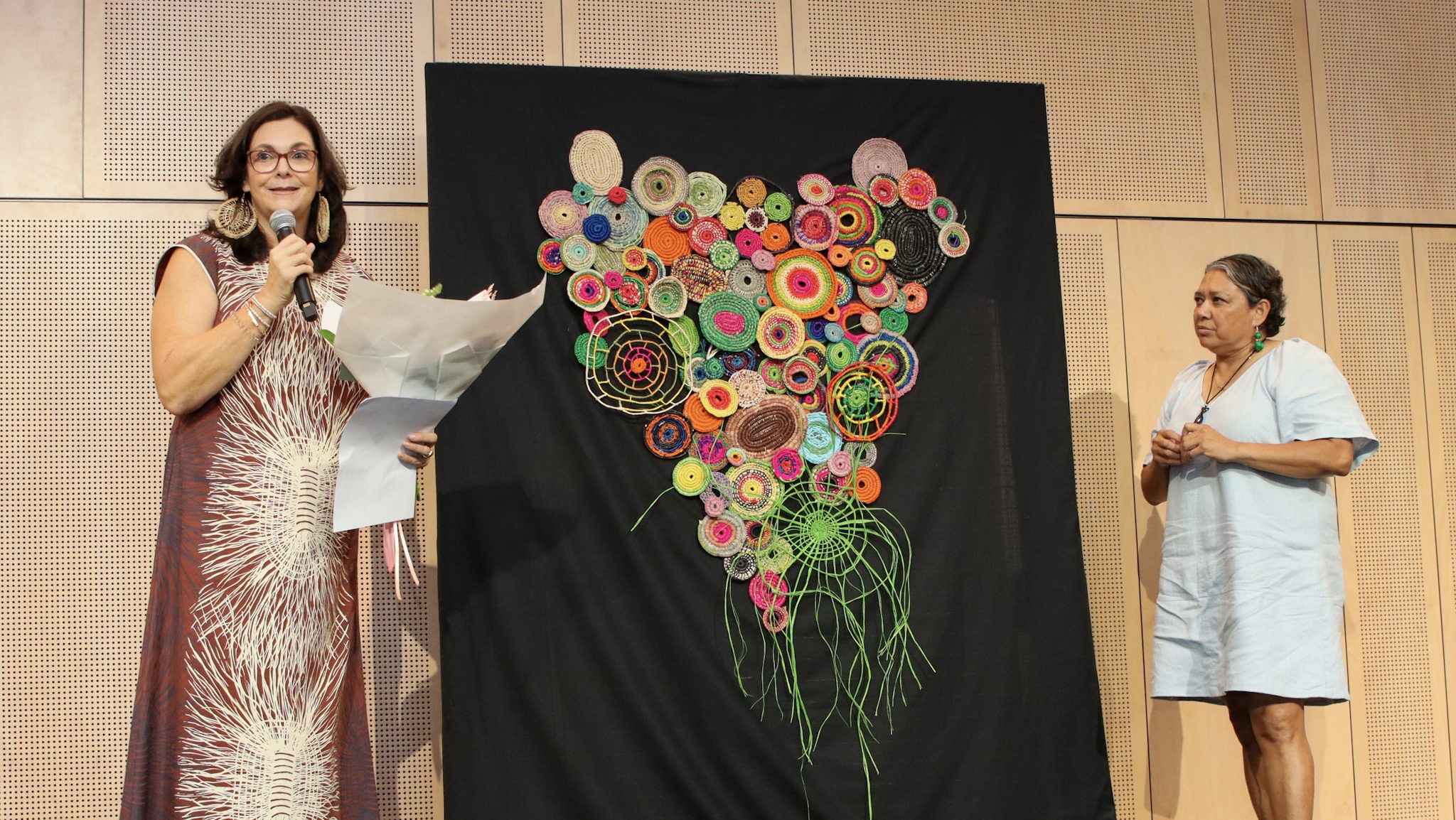
I would like to acknowledge all of the women who have shaped this piece of work, and ask all of the women who have been part of the weaving in Cairns, Lockhart River, Hope Vale and Mossman Gorge to stand for us to acknowledge and thank them.
Floria is the Manage of the CYI Leadership Academy and an amazing bama woman who shaped this work, and brought this piece of calm and strength to our conversations
Floria I want to ask you to hold this piece at the Baninh Yeeum building, as a symbol of what’s possible when many hands, heart and minds come together to create change. We will build on this together.
Thank you.
MAKE AN IMPACT
Your support will empower Indigenous Australians in Cape York and beyond to create positive change in their communities. Every donation, large or small, can create a ripple of change that will span generations.