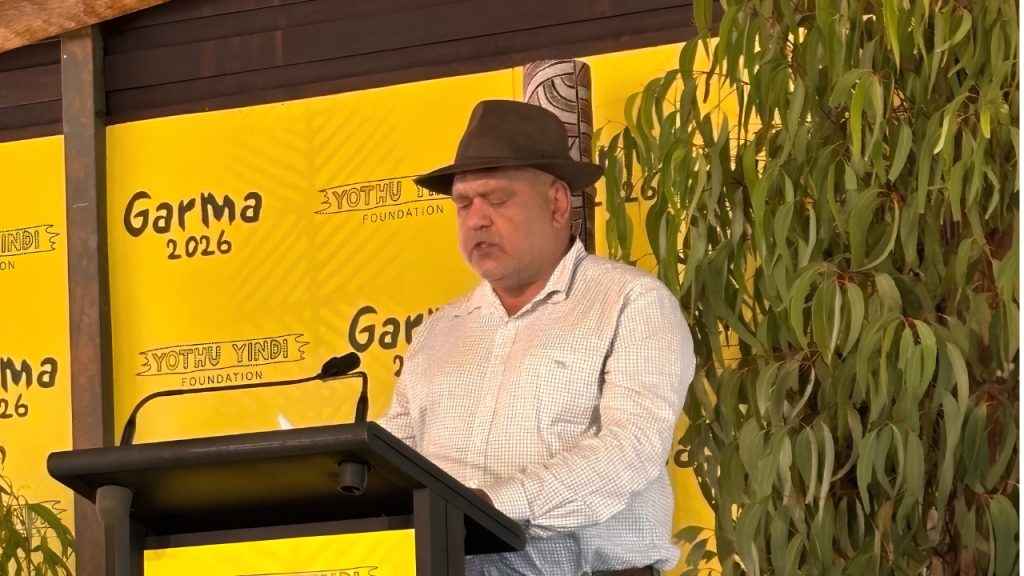
The following speech was delivered by Cape York Partnership Founder Noel Pearson at Garma Festival 2026
I last spoke here in 2023, the year of the Voice referendum.
I do not want to relitigate that time, but will recapitulate what we sought in that ill-starred campaign. These were my 272 words worth:
This referendum, if affirmed, will complete the Commonwealth of Australia through constitutional recognition of its indigenous peoples.
These words, enshrining the presence of peoples whose ancestors made this continent their home for more than 60,000 years, are proposed: In Recognition of Aboriginal and Torres Strait Islander peoples as the First Peoples of Australia.
It makes a constitutional Promise to the Aboriginal and Torres Strait Islander peoples only the Australian People can make: There shall be a body … to be called the Voice.
The Purpose of the Voice is to: make representations to the Parliament and the Executive Government … on matters relating to Aboriginal and Torres Strait Islander Peoples.
It grants Parliament the power to make laws with respect to matters relating to the – Voice – including its composition, functions, powers and procedures. Parliaments will create and alter the details of the Voice, but there will always be a Voice.
These words Uphold the Constitution whilst Recognising the First Peoples.
This Referendum will test the proposition as to whether a nation conceived in the fiction of terra nullius – a continent without owners – and a long refusal to recognise the meaning of the indigenous presence – can come to a new understanding of who we are:
A nation blessed – with an Indigenous heritage spanning 60 millenia – a British institutional heritage captured in its Constitution – and a multicultural unity that is a beacon to the world.
Our nation will have a new birth, and the world will learn that – with justice – what remains wrong can be put right, and though peoples can never forget – they can forgive – and it is never too late for reconciliation.
Good morning. For this undeserved honour I thank the Gumatj.
I am so pleased to be here with my Yunupingu family.
I first came to North East Arnhem Land when 22.
The fiction of terra nullius reigned still. I was contemplating, at my elders’ behest, how we might pursue our land rights in Cape York Peninsula.
I met Ray ‘Good Boy’ Morrison – Joe’s uncle – at a conference in Cape York in 1988. I told him I wanted to visit the Northern Land Council. He introduced me to director Mick Dodson. In retrospect I came to see what a mentor Ray had been to the callow young man I was. My gratitude went unexpressed but my debt was clear.
On the way back through Gove, I met with Galarrwuy at Gunyangarra. That meeting left me resolved to establish the Cape York Land Council.
I am so pleased today to hear Djawa’s announcement to take forward Galarrwuy’s vision to found a Land Council to be led by the Dilak of North-East Arnhem Land.
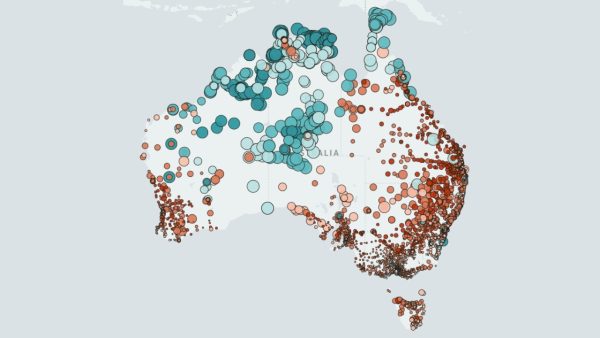
This map, produced using AEC and ABS data in the wake of the vote told us of the polling booths where the majority of voters voted yes or no. The orange voted no, and the blue voted yes.
The greater part voted orange. Urban, regional and settled parts of the country overwhelmingly voted no.
The blue dots that voted Yes correspond with remote and discrete indigenous communities in Far Northern Queensland and the Torres Strait, the Northern Territory and the central and western deserts, and the northern and desert regions of Western Australia.
The discrete Indigenous communities of Australia, Aboriginal and Torres Strait Islander overwhelmingly wanted the Voice. The rest of the country did not.
I come from one of these blue dot places. We number little more than 100,000 Australians, most of us from communities of less than a 1000. In a nation of 27,000,000.
The communities whose lives were most directly shaped by the proposal overwhelmingly wanted a Voice recognised in the Constitution.
Fifty kilometres from my blue-dot home is the orange-dot township of Cooktown. Captain Cook spent six weeks there in 1770. I was born in its hospital. In 2023, Cook’s town voted ‘no’.
This story was repeated across the continent.
The Uluru Statement from the Heart was our prayer to the Australian people.
There was hope in its words.
The Statement was written with love. It stands as probably the most beautiful unrequited letter of love in Australian political history.
For those of us who urged faith, hope and love, there is an account to be given for the hopes raised, the faith urged and the love lost in the referendum.
I must account for that.
And I owe that account to the people in the blue-dot communities of Australia.
So three years later, I stand here with great reluctance.
What right has anyone to raise hopes when those hopes were so badly misplaced?
What right has anyone to offer a vision that turns out to be a mirage?
That is the source of my hesitation to speak of these things. But I cannot allow the failure of the referendum to excuse me from my responsibility. My duty on behalf of the blue-dot communities.
What we sought was to secure their future. This is how the Statement spoke of their predicament:
Proportionately, we are the most incarcerated people on the planet. We are not an innately criminal people. Our children are aliened from their families at unprecedented rates. This cannot be because we have no love for them. And our youth languish in detention in obscene numbers. They should be our hope for the future.
These dimensions of our crisis tell plainly the structural nature of our problem. This is the torment of our powerlessness.
That is why these blue-dot communities wanted the Voice.
Because from the very beginning of my public life, it was, and still is, the future of those communities – not least my own – that has been the central focus of my wakeful dreams.
Our present is not good. And nor is our future assured.
The things that worried me when I was 22 now distress me at 61.
When I was 22, I worried because we knew something needed to be done, but we did not yet know how to do it.
Now, we are much clearer.
We know what we need to do.
We know what we want to do.
We have the leadership to do it.
We have the resolve to do it.
We have the capacity to do it.
We are pretty clear on that now, and we have been for a while. We have a clear agenda.
We have a rising generation of community and regional leaders ready to make this agenda their life’s work. They share with me that sense of duty I felt when I met Galarrwuy age 22.
This leadership is driven by our young women. We have raised a new generation of honest, hardworking and strong leaders to carry the mantle of our elders. That they are young women pleases and astounds me. They are competent, relentless and carry the love of and for our people.
They have the ingenuity, the resolution, resilience and know-how of Lee Kwan Yew, and Paul Kagame, Jacinda Ardern and other nation builders who have seized the destiny of their people. But they only have a fraction of the power they will need to sustain a generational change in the prospects of our people.
The challenge going forward will be for our young leaders to build their moral power to insist that our little ones deserve a future in their own land, and turn it into the requisite political power to bring structural reform into reality.
When I was 22 I was surrounded by my old people. I followed them. You cannot imagine how blessed I feel to see the rising generation of our young women following the leadership of our old people.
We have a plan. I’m going to ask Fiona, as a Co-Chair of Cape York Partnership and Empowered Communities to speak to our agenda to close the gap.
The blue-dot communities of our homelands stand in grave need of healing. There is no better solution to healing individuals, families and communities than guaranteed work.
The social, economic, and cultural capital of these depleted communities will rebuild and replenish with guaranteed work. No program, no intervention, no initiative can do for these communities what guaranteed work can.
They will start to heal. They will start to grow. They will start to strengthen.
Nothing is more important for the reconstruction of the blue-dot communities than guaranteed work.
Then there is the development goal: developing the human and economic capital of Aboriginal people in these blue-dot communities. Before enterprise, before industry, the best strategy for economic development is education. It is by developing the capabilities of children in their education that we will develop economically.
There is no more important economic development strategy than the education of our young. Enterprises, industries, and wealth creation and asset accumulation will come when our young people are educated to pursue these opportunities.
We need human capital today to build financial capital tomorrow. That is why we need an Education Guarantee. Every child in these blue-dot communities needs to be guaranteed an education.
When I started my advocacy, grog was the main problem.
It took fifteen years before governments were forced by us to act.
When they finally implemented the alcohol management plans we advocated, the results were fundamental.
Royal Flying Doctor injury retrievals fell by more than half.
That should have taught us something. Instead, governments repeated the same mistake. Cannabis, previously unknown to our communities, spread unhindered. Now Ice is the neglected crisis of our communities.
Whatever progress we made with alcohol has since been undone by governments of both persuasions, conservative and Labor.
Alcohol supply has expanded, and women and children are experiencing the worst recorded violence in more than twenty years.
In 2025 alone, more than 1,100 women and children were recorded as victims of assault across Cape York’s discrete communities. So far this year 513 women and children have been victims of assault.
Until political parties sever ties with vice industries – grog and gambling – little will change. The poor are a gold mine, said the economist Thomas Sowell. The CLP, LNP and ALP when in power, belief it is the divine right of the vice industries to make a profit from the immiseration of our people.
Child protection tells the same story.
Queensland is a serial inquirer, yet children entering out-of-home care has continued to rise.
Under the Beattie Government, Queensland spent a decade building an outsourced industry around the management of child and family crisis.
They turned our children into fodder for a parasitic industry.
By the time that disaster was obvious, there was another inquiry. More than a decade after the Carmody inquiry, the government this week announced its response to the third child-safety commission of inquiry in less than 30 years.
In 1998, around one in five children in out-of-home care was Indigenous.
Today, it is one in two.
Queensland thinks it can remove its way out of this crisis. It has created a billion-dollar system that waits for harm to be done to children, instead of investing in strengthening families before harm escalates, and confronting the grog that causes the dysfunction in the first place. Protecting the publicans and gambling outlets are their abiding concern.
In ten years I predict now there will be more children in that system, and an even greater proportion will be Indigenous.
Child protection will worsen. Youth justice will worsen. Adult incarceration will worsen.
Not because we do not know what to do, but because our governments won’t let us do it.
After nearly ten years of the Palaszczuk Government, Cape York made no sustained progress towards Closing the Gap – and in critical areas, the gap widened.
In the lead-up to the 2024 Queensland election, I wrote to then Premier Steven Miles and Leader of the Opposition David Crisafulli:
What we have seen is that if you pursue ‘progressive’ policies unable to deliver results, you end up having to resort to regressive policies anyway. Regressive ‘tough on crime’ law and order style approaches alone, however, also do not work. In combination, the progressive focus on more and more ineffective services and programs, and the regressive focus on tough on crime policies, can result in nothing more than entrenching disadvantage for young people, their families, and communities even further.
But we have no chance under the current arrangements. Our children are caught between the Scylla of the soft bigotry of low expectations of Labor governments and the Charybdis of the hard bigotry of the Liberal Nationals.
The inability of governments to deliver the reforms our people need is no longer only a moral failure but a civilisational one. The destruction of the blue-dot communities of remote Australia is truly at stake.
Consider what is called Indigenous expenditure.
In 2010-11, governments attributed $25.4 billion in direct expenditure to Aboriginal and Torres Strait Islander Australians. By 2015–16, that figure had risen to $33.4 billion. The figure is no longer officially updated.
Australians heard these numbers and imagined that vast sums are being handed to Indigenous communities.
That is not what the figures mean.
In 2015-16, 82 per cent of the expenditure attributed to Indigenous Australians was expenditure through mainstream government services. Only a fraction is Indigenous-specific expenditure.
Much of this is expended through mainstream State and Territory systems. It includes Medicare, schools and hospitals. But it also includes policing, courts, out-of-home-care, youth detention and prisons.
The Commonwealth provides much of the funding, while the States and Territories control many of the systems through which it is spent. What can you do if your state chooses to spend it on detention, over education?
So we have an agenda.
Fiona outlined our plan to close the gap by 2050. We know what we need to do, and we know what governments need to do to support us.
Our plan may fall into the abyss of federalism. There simply is no precedent to change the institutional architecture required to ensure these foundational obligations: work for the parents, education for the children.
These foundational obligations are owed to the future of our children.
But none of this will happen under our present arrangements.
The 1967 referendum gave the Commonwealth Parliament jurisdiction over Aboriginal affairs, which it had lacked since federation. Just ten years later, the first crisis of federalism in Aboriginal affairs under the new power occurred in the Queensland communities of Aurukun and Mornington Island.
A dispute erupted over bauxite mining in Aurukun between Premier Joh Bjelke-Petersen and the community. The Uniting Church supported a legal challenge in the Queensland Supreme Court and the Privy Council, leading to retribution by Bjelke-Petersen.
The church was ousted. The mission became a government settlement. This was the infamous Aurukun Takeover.
The leaders of Aurukun implored the Commonwealth through the Department of Aboriginal Affairs to assume responsibility for the community. They wanted to be free from the jurisdiction of Bjelke-Petersen’s government.
Then Liberal Minister for Aboriginal Affairs Ian Viner, with Prime Minister Fraser’s support, legislated to enable Aurukun and Mornington Island, and other communities that so desired, to come under the jurisdiction of the Commonwealth.
This was the Aboriginal Councils and Associations Act of 1978, the precursor to Corporations (Aboriginal and Torres Strait Islanders) Act 2006 CATSI Act. The people of Aurukun were hopeful that the Fraser Government would bring their community under the jurisdiction of the Commonwealth.
Since the 1978 betrayal by Fraser and Viner, many indigenous organisations were formed under the association provisions of the 1978 Act, but the Council provisions – developed specifically for Aurukun and Mornington Island – never were.
The parlous history of Aurukun began then. A canteen was forced upon the community in 1985 and the destruction has continued unabated since.
In the 41 years since the Aurukun Takeover, I have often wondered what Aurukun would have been like today had their desire to be free from the jurisdiction of the Queensland Government and instead had a direct relationship with the Commonwealth been honoured by Fraser.
A long-standing anthropologist associated with the people of Mornington Island, David McKnight, wrote an indictment of the system put in place after the 1978 takeover called From Hunting to Drinking.
It is now time to consider a fundamental structural reform to the governmental jurisdiction of the blue-dot communities.
The Fraser–Viner policy from 1978 that was legislated but not acted upon must now be revisited. The blue-dot communities of remote Australia must become the sole jurisdiction of the Commonwealth. These communities and their lands would still come under the shared jurisdiction of the relevant states and territories for most functions governed by the state’s constitutional responsibilities, but the administrative relationship for Aboriginal affairs would lie with the Commonwealth.
There should be no need for Aboriginal Affairs departments in the states and territories.
This would rationalise duplicated governmental systems and institutions. It would stop Indigenous affairs being the black hole for state and territory government budgets.
A direct funding relationship between the Commonwealth and the organisations representing and serving these blue-dot communities will enable development agendas such as the Personal Responsibility and Opportunity Act of Cape York Peninsula to receive the budgetary support it needs to close the gap.
After the rejection of the Voice, the conversation about structural reform of the federal arrangements governing Indigenous affairs must resume. If not a Voice, then let us ask the question Dr King asked in two years after Civil Rights and one year before his assassination: where do we go from here?
Thank you.
FOR THE LOVE OF OUR CHILDREN
Please consider making a tax-deductible donation to Cape York Partnership before 30 June. Your donation will create real opportunities for First Nations families to take responsibility and build a stronger future.