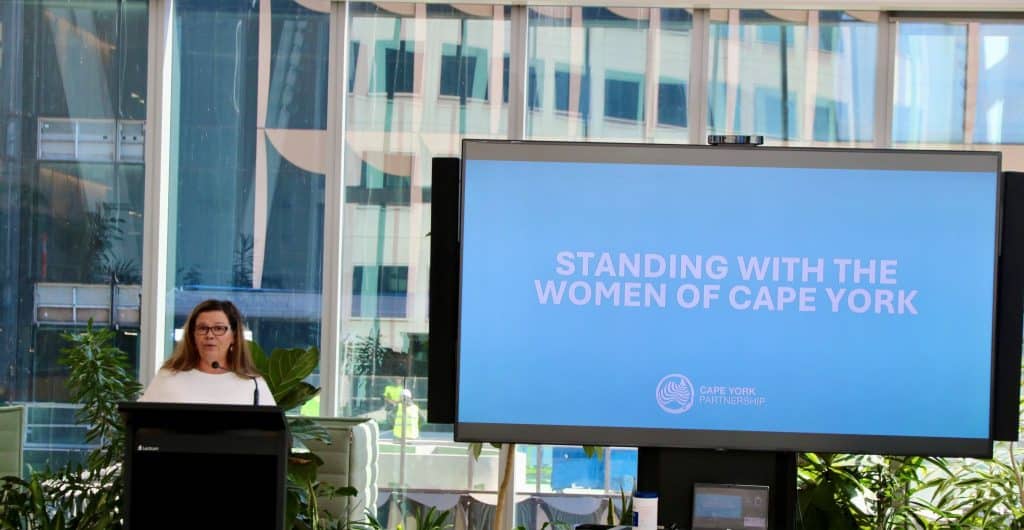
The following speech was delivered by Cape York Partnership Executive Co-Chair Fiona Jose at Jawun's Stories of Female Leadership (SOFL) gathering.
Yalada yuda, yulumbarril, nayu wawu wawu.
It is an honour to stand before this strong gathering of women today.
Leadership begins in stories. A story tells us what a statistic cannot: who saw the problem first, who carried its consequences, who had the courage to name it and who found the energy to do something about it.
The stories I want to tell today are about the women of Cape York.
They carry the work of family life. They carry the work of community life. They carry the consequences when a public system fails them.
More than 20 years ago, at the start of the Cape York Welfare Reform work, Hersey Yunkaporta walked in off the red dirt main street of Aurukun carrying fifty dollars in cash.
She was there to see a Westpac secondee supporting our very early reform engagement. Hersey's son had passed away, and she was determined to save for a proper headstone.
In a remote community where cash is constantly pulled in many different directions by the consequences of passive welfare and grog, holding onto money is almost impossible. Hersey was motivated by a fierce, maternal love.
She asked us to lock that fifty dollars away for her. Then she came back the next fortnight with another fifty dollars. And another. That Westpac secondee put her money into a locked cashbox.
Hersey was not asking somebody else to take responsibility for her life. She was asking for a practical way to protect the love and discipline she was bringing to her family.
That single act of maternal devotion by Hersey Yunkaporta did not just buy a headstone. It sparked a structural revolution.
Hersey's initiative became the foundation of our Family Income Management, financial literacy and accounts for safekeeping. That evolved into Student Education Trusts (SET), where many individuals can contribute to a child's education.
We now have a suite of financial protection products and a tech platform built in Cape York to protect family and household income.
The numbers tell their own story.
Our women have put away nearly $6 million of their own money for their children and households.
Women are leading the way in taking up these Opportunity Products, prioritising their families and demonstrating remarkable consistency and commitment.
They account for 52 per cent of O-Hub members and 72 per cent of Pama Platform users.
Women have made 80 per cent of contributions to READY, SET and GO accounts for children's education, amounting to $4.4 million.
They account for 70 per cent of Personal Saver contributors, representing $800,000 of the $1.16 million contributed towards building household assets.
Women also account for 69 per cent of Bayan contributors, representing $127,000 of the $190,000 contributed towards home ownership.
They make up 62 per cent of Homelands account contributors and have contributed $202,000 of the $256,000 saved towards land expenses.
And 78 per cent of all budgets completed on the Pama Platform are by women.
I have spent most of my working life listening to those women.
I have no doubt that Cape York women are the unbroken backbone of our communities.
In my Yalanji language, Jalbu Jalbu means "many women".
Jalbu Jalbu is the way I have learned to work.
One woman comes to us with a problem. But it is rarely only one woman's problem. So we bring women together.
We sit with it. We put the stories alongside the evidence. We test our assumptions against what women are actually living. Then we build.
Sometimes we build a program. Sometimes we build a campaign. Sometimes we build a new pathway for children. Sometimes we take women directly to the people making decisions.
Jalbu Jalbu gives women space to turn what they know into something that can act in the world.
Doreen Hart OAM is one of many courageous family leaders who said enough is enough to the drinking, the violence and the dysfunction that had overcome our communities.
They wanted children at school. They wanted households kept safe and in good order. They wanted family income protected. They wanted parents supported to take responsibility. They wanted local authority to have a practical role in preventing harm long before a family reached crisis.
They wanted a tough-love approach.
Doreen stood up as a leader amongst leaders, becoming a founding Local Family Responsibilities Commissioner in Hope Vale.
The Local Commissioners work directly with families around school attendance, child safety, rent, justice matters and financial responsibility. They have legislated powers to assert real consequences for those people not meeting their family responsibilities.
Eighty per cent of local Family Responsibilities Commissioners are women.
Despite the Family Responsibilities Commission being one of the nation's most successful mechanisms of locally led social change, the State Government relentlessly tries to defund and shut it down.
Each time, I have brought these women together in campaign. We have written letters, run media offensives, held public forums and taken our concerns into Parliament.
Women have the authority of their own experience.
My responsibility is to help create the platform, the preparation, the evidence and the connection that allow their authority to influence the world beyond their communities.
Phyllis Yunkaporta and the late Annie Creek are educational pioneers.
These women recognised early that without high-quality literacy and academic discipline, our children would remain locked out of the modern economy.
They campaigned tirelessly to bring real and rigorous education. They lobbied for the high-impact learning of Direct Instruction into Coen and Aurukun classrooms, to great success.
Phyllis is a key Elder, a champion of ancestral languages, land reform and education.
Another example of the power of women's leadership is Tania Major.
As a young lawyer, our founder, Noel Pearson, sponsored Tania's boarding school education after hearing that her mum, Pricilla, had been holding bake sales to raise money to send Tania away to a good school.
Tania was the first in her community of Kowanyama to complete a university degree.
She came back to Cape York Institute to build the Cape York Leaders Program. She mentored students, became Young Australian of the Year and a formidable rights campaigner.
She used her national platform to expose the systemic failure of remote Indigenous education, demanding that young Pama receive the exact same quality of schooling and opportunity as any child in Sydney or Melbourne.
The women of Cape York have also led the longest and hardest struggle of all: the fight for fundamental safety.
For us, alcohol policy is never just about a supply licence, a canteen or a carriage limit.
It is a child safety policy. It is a family income policy. It is a school attendance policy and a work policy.
It touches every single corner of family life.
Nowhere is this intergenerational battle clearer than in Aurukun with the late Allison Woolla and her daughter Keri Tamwoy.
Two generations, decades apart, taking on the very same crusade.
Allison became Aurukun's first female mayor and shut down the wet canteen, fighting back against state policies that forced alcohol onto her community after taking over the Mission.
Keri, a graduate of our Leadership Academy who later became a local peacemaker, the Thaa Puunt, and Mayor herself, remembers growing up in that storm.
She remembers waking each morning to step over domestic carnage, giving up her bed for bloodied, bandaged women seeking refuge and counsel in her mother's home.
That fight is far from over.
Today, the crisis remains urgent.
In 2025, 1,142 women and children were recorded as victims of assault across Cape York's discrete Indigenous communities.
Another 392 women and girls have already been recorded as assault victims in just the first half of this year.
Our women experience a rate of domestic violence order breaches 13 times higher than the broader Queensland population.
Our question to governments is this: Is the safety of First Nations women and children in Cape York held in the same high regard as the safety of women anywhere else in Australia?
It is my role and responsibility to bring women together to analyse the data against their lived experience.
The women are gathering around the history of Alcohol Management Plans, seeing the police violence data for the first time against the escalating carriage limits.
Knowledge is power.
These stories are just a snapshot of the grit and gumption of our women.
What unites them is a fierce, protective anger born of maternal love.
We must not misunderstand anger or fear it.
The anger we hold for injustice is not rage or hate. Anger, fused with love, is the most potent constructive force for structural reform. With this energy, we learn the problem and the change required.
Noel Pearson once said:
"There is no more jealous, and no more powerful a driver of progress than the tender regard that a mother has for her own… The mother whose jealous regard is for the prospects of the children is the most powerful engine for social progress."
Noel is right.
Cape York women are the powerhouse for change.
Nothing moves a community forward quite like a mother's jealous regard for the prospects of her children.
From the very beginning, the Cape York reform agenda has recognised this strength.
Noel has now handed me the baton to lead the next chapter of that reform, and my own mantra is simple: we cannot wait for governments to save us.
We must take responsibility for the future of our children, while demanding that governments meet their responsibility to provide equal opportunity.
A mother's fierce regard for her child does not end with anger at what is wrong.
Cape York has enough fire.
Women know that better than anyone: the fire of violence, school failure, joblessness, poor health, family pressure and the daily struggle to hold things together.
I have learned that leadership does not add more fire. It finds water.
That is the work I have tried to do in my own leadership: to take the problems women bring forward, gather the people who understand them best and help turn their fierce regard for their children into brand new pathways.
Let me share some more stories.
Grannies and Aunties came to me worried in particular about "children having children", dropping out of school and severely stunting their life chances. They were also worried about young girls who had disengaged from education for many other reasons.
They knew so well the life course for those girls and wanted to change it.
They wanted a place where girls could receive very special attention and protection, and where young mums could learn and live together with their babies.
My responsibility was to carve a pathway that had never existed.
We brought women together around that concern, and we created the Cape York Girl Academy, Australia's only boarding school for girls and young mothers who have been chronically disengaged from their schooling.
I learned another lesson through employment policy.
For years, people in Cape York were asked to participate in the Community Development Program, sometimes known as work-for-the-dole.
Jobseekers attended appointments. They completed job plans. They did training. They met requirements. They demonstrated willingness.
But in our communities, 85 per cent of people are jobless.
There was no real job at the end of it. And government was throwing money at unemployment, not employment.
I set us a goal of creating 300 real jobs in three years.
I have recently reported to our Board our results: we created 281 jobs out of the 300 target.
Those jobs brought way more than income.
They brought routine, dignity and a reason to get up in the morning. They gave children the daily experience of seeing an adult leave home to work.
For years, government policy has failed people very badly.
We can and should be angry, and we should get fired up.
I am very careful about fighting fire and whether more heat is needed or not.
Fighting this fire with water has led to a slow process of reform, but reform no less.
Leadership can also mean taking advantage of a crisis.
Our communities had long complained about the ridiculous cost of food, close to three times more expensive than urban or regional prices.
It is also true that most of our Cape and Torres Strait community stores are owned by the State Government, so changing that was not imminent.
Then COVID hit.
Communities were shut down and unable to travel to bigger centres for more affordable food.
Was this the time for us to shake things up?
Of course it was!
I brought together the women who had been stranded in Cairns as a result of the lockdown, and we designed a food delivery system at Cairns prices.
Fresh food boxes, designed by the women, making their dollar stretch further.
The Mayi Market food box delivery has expanded to include hygiene products and cleaning essentials that many households had been going without.
This has been one of the hardest projects to break even. We cannot access the same freight subsidies as the government and privately owned stores.
But as a leader, you have the power to give weighting to purpose over profit and find ways to make it work.
Leadership asks certain things of the leader.
For me, that became clear through a program in Mossman Gorge called Wubul Dandi.
One in three people in Mossman Gorge have diabetes. Their lifespan, on average, is 58 years.
They took big leadership on this.
They raised money themselves to bring in diabetes expertise, including Ray Kelly from The Biggest Loser television show.
For them, diabetes had brought terrible sickness, disability and too much grief for children way too young.
And it is women who carry households through the practical and emotional burden of this chronic illness.
I watched Mossman Gorge get this program up, and I cheered them on.
But it took several months for me to self-reflect on my personal situation.
They had both hit a nerve and inspired me.
I sent the lolly jars packing out of the office and substituted them with almonds.
I got moving. I made an eating plan. And I have lost 35 kilograms.
I had realised that leadership is visible.
People watch whether you are prepared to do the hard work that others are taking on.
The Mossman Gorge leadership has united people socially around a subject that has previously brought much shame.
They taught me that it is not always about the end goal, but that discipline and consistency along the way are the goal.
It has been a good lesson and cemented a leadership I truly believe in: the type that walks with people.
A leadership that creates an environment in which people can see possibility in themselves.
I want to take us back to Noel's insight.
A mother's tender regard for her child's future is one of the greatest forces for social progress.
I am very grateful to speak with SOFL.
We are here for those women, to support them, to raise their voices and to protect the next generation.
Women's leadership is a force that multiplies.
You know too well that women with access to networks, knowledge, confidence, capital and platforms create opportunity for others.
We mentor, we employ, we connect, we advocate, we raise children, we strengthen families.
The uniqueness of our network is that we recognise First Nations women as peers.
As leaders, innovators and builders who need partners who will listen, learn, connect and stand alongside them.
Every woman has a story.
It's never simply a story, because it's never simple.
Women are the unbroken backbone of our communities.
I am proud to stand among them. I am proud to stand among our SOFL network and with you all.
Yalada yuda.
Thank you.
FOR THE LOVE OF OUR CHILDREN
Please consider making a tax-deductible donation to Cape York Partnership before 30 June. Your donation will create real opportunities for First Nations families to take responsibility and build a stronger future.