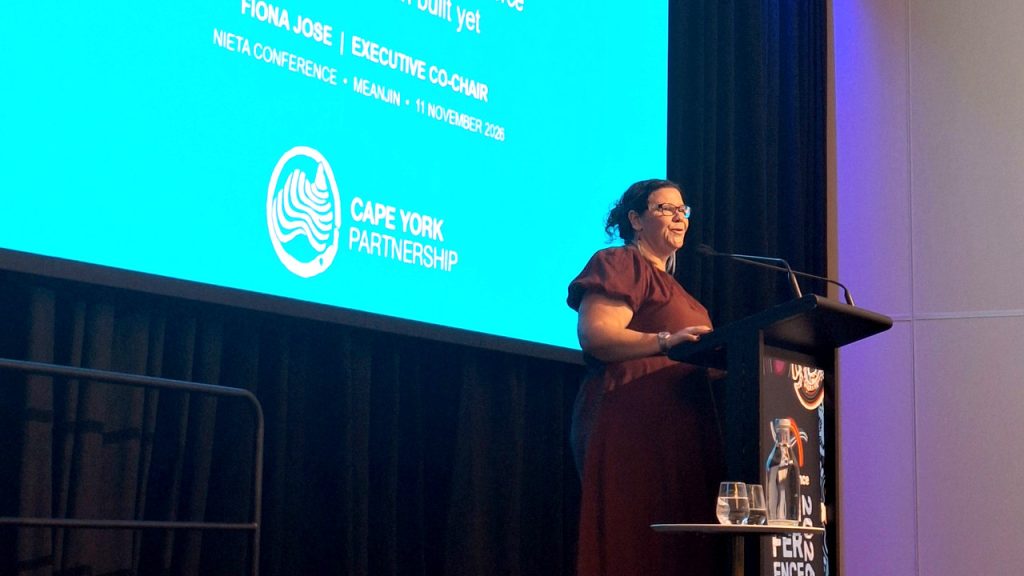
Fiona Jose, Executive Co-Chair, Cape York Partnership – NIETA Conference, Meanjin (Brisbane), 11 November 2026.
How to succession plan a workforce that hasn’t been built yet
Yalada yurra, yulumbarril, ngayu wawu wawu.
I acknowledge the Traditional Owners of Meanjin, and their Elders. Thank you to the NIETA conference hosts, it is an honour and pleasure to be with you. I bring greetings from Cape York Peninsula.
Every leader in this room has asked the question, usually late at night who comes after me?
It is a good question. But we usually ask it too late, and at the wrong level.
We ask it about a CEO, a board chair, a senior manager. We draw up a list of names. Too often the list is short. Sometimes it is even empty. And we wonder why.
When I was asked to speak about succession, I was excited, because it is a topic our Old People, who founded the Cape York reform movement, were desperately concerned about. They asked the same question, but differently.
Their words weren’t – who would replace a CEO or chair the next board. They were asking whether the next generation would be strong in mind, body, culture and capability strong enough to carry the mantle of leadership, and to go further than they had been able to go in this hard country of ours.
At the first Cape York Summits in the early 1990s, they spoke firmly about what our young people would need: health, discipline, education, and the practical capabilities to carry their family responsibilities. These were the foundational things they had watched unravel under passive welfare.
That is my argument today. Succession is not a handover at the top. It is the depth of the bench.
Leaders do not appear from nowhere. They come out of a population of people who can read and write, who have held a job, who have carried responsibility, made mistakes, recovered, and been trusted with more.
The deeper that pool, the more leaders a people produces. The shallower it is, the more we depend on a handful of exceptional individuals, and on capability brought in from somewhere else.
I know this because I stand before you as one result of that investment.
Almost twenty years ago, I was brought into the Cape York reform movement. I was supported through the Cape York Leadership Academy, through intensive mentoring, sabbaticals, training and continuous professional growth. I was not supported for a single job outcome. I was supported so I could learn the real ropes of reform, master critical and developmental thinking, and build the capability to develop others.
When Noel Pearson, our founder, handed me the baton, it was not a sudden handover. It was the result of two decades of deliberate investment in a person’s capability. I am the product of an Aboriginal Community-Controlled Organisation that did not wait for a contract to invest in its people.
And I am not the only one. Over two decades, more than 650 young people have come through the Cape York Leaders Program, and more than 500 through our Leadership Academy for youth and adults. Here is the honest truth: we did not know at the time that we were investing in our workforce. We thought we were investing in leaders. It turned out to be the greatest uplift our organisations have ever had.
As a Bama doing this work in place, with my own people, I have a clear view that my role is to set high expectations, to have ambition, and to stretch ourselves to deliver for our people. That is what was done for me, and it is what I owe the people coming after me.
So, if we are serious about succession, we have to look at the whole bench, not just the top of it.
In Cape York communities, 58 per cent of working-age people are not in work. In Aurukun, it is 85 per cent.
For a young person who stays in their community for high school, the chance of finishing Year 12 is less than 1 in a 100.
And across mainstream employment services, fewer than 1 in 9 people move into even 6 months of sustained work.
You cannot succession plan a workforce you have not developed. It is like designing the roof before anyone has poured the slab.
But there is another figure that matters even more. When young people from those same communities are supported to attend good schools through the Cape York Leaders Program, 95 per cent of them finish Year 12. That is well above the national average of only 77%. Same families. Same communities. Same children. A different institution.
That contrast tells us where the problem lies. It is not in our children. It is not in our people. It is in the institutions around them. And institutions can be changed.
This is not only a Cape York story. All the talk in Canberra and in corporate boardrooms is about national productivity. Yet almost no one is talking about the Australians trapped at the very bottom: what we call the Bottom Million, around a million people locked in entrenched, intergenerational disadvantage. First Nations people make up half of those trapped at the bottom.
This is not a compliance problem. It is a human development problem.
Reciprocity
Reciprocity is not a foreign idea to us. It is written into our Lore and culture. You share what you harvest. You carry your weight. You look after kin and Country. In many of our ancestral languages there is no direct word for “thank you”, because sharing and mutual benefit was never an optional courtesy. It was simply who we are in our cultural DNA.
But Governments have distorted this into a one way instrument called “mutual obligation’, built a multi-billion-dollar apparatus to enforce compliance on jobseekers while taking itself completely off the hook for making sure jobs actually exist.
From Cape York, we have proposed a law to supply that missing accountability: a Personal Responsibility and Opportunity Act, the PR+O Act. If our people step up to exercise responsibility, government must reciprocate with the opportunity of real work. I will come back to the mechanics.
But why does government refuse to guarantee work? To answer that, we have to remember how we got here. This predicament did not begin with a lack of work ethic or capability. It is 150 years in the making.
For more than a century, Aboriginal labour carried the pastoral economy of this continent. When the gold rushes drew European workers off the stations, our people kept those stations running. Our grandfathers and grandmothers were the stockmen and cattlewomen, drovers, shearers, fencers, butchers, timber cutters and teachers. They mastered their crafts in country that broke other people.
And they were proud of it. Ask any of the old stockmen. That pride was real, and it was earned.
The indignity was never in the work, it was that Australia refused to value it.
Our people were paid in flour, tea and tobacco while the white stockman beside them was paid in cash. In Queensland, the Protection Acts of 1897 and 1901 allowed the Protector to direct employers to pay Aboriginal wages to the Protector instead of the worker. Government control of our wages and savings did not end until 1972. Those are the Stolen Wages.
Then in 1966, the Arbitration Commission decided that Aboriginal stockmen should be paid award wages. It delayed the start until December 1968, and it explained why in writing. The delay was, and I quote, to give pastoralists “an opportunity to consider the future of their aboriginal employees and to make arrangements for their replacement by white labour if necessary”.
That is what happened. Families were turned off stations where they had lived and worked for generations, and dumped on the fringes of towns. In Queensland, Aboriginal workers did not win equal wages under state law until 1986.
Think about what that teaches us. When our labour was cheap, Australia wanted it. When it had to be paid what it was worth, Australia did without it.
Governments have reshuffled the deck chairs and left the fundamental problem untouched. They have misdiagnosed a development problem as a compliance problem. They have treated our jobseekers as if they lacked motivation, and ignored the plain fact that in remote Australia, a local labour market was deserted.
Cape York has never been shy about responsibility. For three decades our reform agenda has been about taking it back: from a hand out to a hand up. That means responsibility as agency, not blame.
We have shown what it means to follow the evidence. We had once dismissed a universal job guarantee as a socialist demand, because we looked to the private sector to create the jobs. But 30 years of experience taught us that where a market does not form, someone has to guarantee the first rung of the ladder.
The dignity of contribution
When work disappears from a family for a generation, unemployment stops being a short event. It becomes the background of daily life. It strips people of control over their own lives, breaks household routines and shrinks the horizon of hope. It starves people of the pride of purpose.
In Aurukun, a man told us that picking up rubbish as a forced compliance activity made him feel like a slave. Then he did the same work as an employed garbage collector, on wages, with real responsibility for his community. It was completely different, and he told us why: “Because it’s my job!”
The task looked the same. The relationship was not. He was not being managed. He was contributing.
Children notice the difference too. Years ago in Hope Vale, teachers asked primary school Bama what they wanted to be when they grew up. Most said: “I want to be on CDEP.” That wasn’t a lack of imagination. Welfare activity was the only kind of work they’d seen on their streets.
Then under Cape York Welfare Reform the community created a commercial banana farm. Fathers, uncles and brothers went to work every morning on real wages.
And the kids’ aspirations changed. “I want to be a banana farmer.”
When adults work, purpose returns to the home, and children take on the goals of working parents. Work for adults is developmental infrastructure for children.
We should be honest about the barriers too. Generations of exclusion have left deep scars in literacy and confidence. Expecting someone locked out for years to walk straight into a 38-hour week is a fantasy. Mainstream services too often use those barriers as a reason to keep our people collecting certificates from courses that lead nowhere. The best capability building happens on the job, in a real job, through real contribution.
What the system pays for
We support the RJED program. It accepts what many of us have argued for years: that where labour markets fail, government should fund real jobs on real wages. That deserves credit.
But I grapple with time-on-the-clock, duration-centric funding and suggest that the system rewards ‘capability’ outcomes.
What capabilities has that person reached in 6 months, 12 months etcetera? Are they making a budget, managing their wage? Has their literacy for work grown?
We must fund human capability. Can we build a system, a job guarantee that accounts for development not occupancy, capability outcomes? That means keeping people attached to working life, stepping up their opportunities as their skills and confidence grow. Capability accumulates through a supported, sequential journey.
What we have proven in Cape York
I am not arguing from theory. We have done it.
Under Trialling Pathways to Real Jobs, Cape York Employment redirected compliance funding into 46 real jobs across Aurukun, Coen and Lockhart River, at less than half the unit cost of current government programs. Childcare, youth work, language and culture, yard crews supporting older people and people with disability. Demand for those jobs always exceeded supply. When work is real and capability is supported, our people step up. Sometimes the capability is already there and only the opportunity is missing. Elder Phyllis Yunkaporta in Aurukun carries deep Wik Mungkan language and cultural knowledge built over a lifetime. Through the trial we employed her as a language teacher and mentor with the Pama Language Centre, where she developed education materials, recordings and learning modules. A person’s own capability is a smart place to start. And that is succession in its oldest form: one generation handing its knowledge to the next.
Then I wanted to stretch my leaders further, not only in Cape York Employment and our employment service contracts but across all our work. We set a target: 300 jobs in three years. That is 100 jobs a year.
My team had asked me for a target. When I said it, there was silence. Then someone asked a very good question: “How are we going to do that?” I didn’t know, but unless we set goals like this, how will we ever push ourselves to do more?
I can report that we have created 281 of those 300 jobs.
We delivered the services and created those jobs at the same time. It has not been easy. It is intensive work building capability, and it costs money.
We have delivered complex service contracts in Cape York with our own people. Across our operations on the ground, more than 90 per cent of our workforce are local First Nations people. We are extremely proud of that, and we do it under the same scrutiny as every other provider, most of whom do not have a local workforce. But when the choice is between sticking with our people and recruiting from outside to keep government happy, we will choose the development of our people.
We take a long-term view to invest in people over decades, not within the boundaries of a 3-to-5-year government contract.
Holding government to account gives us no licence to excuse ourselves. If we want to succession plan the way the Old People intended, three principles apply to us as much as anyone.
First, build capability on the job. Stop treating jobseekers as products to be referred or placed. Structure roles so that skills, literacy and work habits accumulate through real contribution. My own journey was at the leadership level, but the logic is identical. Capability grows when an institution sticks with a person for the long haul: drawing out their potential, backing them through setbacks, and stepping them up as their confidence grows. If we can invest in leadership for two decades, we can and must do the same for our workforce on the ground.
Second, end the FIFO joint venture trap. Too many joint ventures, with token Indigenous control, fly a workforce into our communities under the banner of Indigenous procurement, and leave nothing behind when the contract ends. An Indigenous interest in a commercial structure has to mean more than an Indigenous name on the letterhead. Joint ventures on our land should carry contractual commitments to train, mentor and move local people into roles at every level, including management.
Third, hold our own organisations accountable. An Indigenous organisation that grows its revenue without growing its local First Nations workforce has missed its core purpose. As a place-based organisation, we don’t wait for a tender to start thinking about our local and regional workforce.
What the next generation inherits
Leadership is an intergenerational obligation. Each generation inherits what the one before it built: its capabilities, its institutions, its assets and its opportunities. And each generation has a duty to leave more than it received.
Our stockmen and women, our drovers left us pride, skill, moral character and an unwavering commitment to carry their weight. They proved, beyond argument, that our people know how to work.
Our Old People left us a reform movement and an obligation to ensure the next generation be strong enough to go further than they could.
The answer depends on what we build now. Fifty years of administrative tinkering and managing unemployment must be tipped out. If we accept a system that manages unemployment, our children will inherit the same exclusion that locked out their parents. If we build the two foundations, an Education Guarantee for our children and a Work Guarantee for our adults, the bench gets deeper every year.
Then our children will dream of way more than CDEP. They will finish Year 12. They will become banana farmers and tradespeople, teachers and nurses, managers and directors. And one of them will stand at this lectern in twenty years, as I do today, and talk about the people who came after her.
That is succession. That is leading forward.
Yalada
FOR THE LOVE OF OUR CHILDREN
Please consider making a tax-deductible donation to Cape York Partnership before 30 June. Your donation will create real opportunities for First Nations families to take responsibility and build a stronger future.